
CACAO HEALTH
Cacao and Stem Cells
What Harvard Discovered About Ceremonial Cacao and Heart Health
Thousands of years of wisdom. Now the science is catching up.
Here's something that might surprise you.
Cacao has been around for over 6,000 years. The ancient Mesoamericans didn't just enjoy it — they prized it as medicine, traded it as currency, and consumed it daily. And yet it has almost nothing in common with the chocolate you grew up with — the bars, the hot cocoa, the Easter eggs. Not in how it's made. And certainly not in what it does for your body.
A growing body of research, including findings out of Harvard Medical School, is beginning to reveal just how remarkable it is.
Especially when it comes to your heart.
What researchers discovered about cacao and heart health
Some of the most compelling cardiovascular research of the last decade doesn't involve a drug, a device, or a procedure. It involves cacao.
In a study published in the Journal of the American College of Cardiology, 16 men and women with existing heart disease drank high-flavanol cocoa twice daily for 30 days. Average age: 64. All on standard medications.
The results , to put it plainly, striking:
- Stem cell counts in the blood increased by an average of 220%
- Blood vessel function improved by 47%
- Systolic blood pressure dropped significantly
What the researchers concluded was this: the natural compounds in cacao — called flavanols — triggered the release of stem cells from bone marrow into the bloodstream. From there, those cells got to work. Repairing. Regenerating. Restoring.
That's the cacao-and-stem-cells connection that has the longevity and wellness world paying very close attention.
So what do stem cells actually do?
Think of them as your body's quiet repair crew.
While you sleep, work, and move through your day, stem cells circulate through your bloodstream doing things you'd never notice — until they stop doing them:
- Healing damaged tissue
- Rebuilding the lining of blood vessels
- Clearing chronic inflammation
- Keeping arteries flexible
- Supporting the growth of new blood vessels
The problem is that as we age, stem cell counts naturally decline. It's one reason recovery slows down in our 40s and 50s. One reason chronic conditions — elevated blood pressure, arterial stiffness, cardiovascular disease — start showing up.
The more stem cells you have circulating, the better your body can look after itself. Which makes the research on cacao and heart health genuinely exciting — not as a cure, but as a remarkable, natural support.
A people who drank cacao every day, and what happened to their hearts
Long before this clinical research, a Harvard Medical School professor stumbled onto something he couldn't explain.
He was searching for a genetic factor that protects against high blood pressure. Instead, he found a population — the Kuna people of Panama's San Blas Islands — with cardiovascular disease rates nine times lower than the global average. Hypertension was almost non-existent, even among the elderly.
Genetic advantage, he thought. Had to be.
He was wrong.
When some of the Kuna migrated to mainland Panama and adopted a modern diet, their blood pressure rose to match everyone else's. The protection wasn't in their DNA. It was in what they were drinking every single day.
Up to five cups of traditionally prepared cacao.
Because the islands had no natural freshwater, the Kuna boiled river water and flavored it with cacao — and had done so for generations. They may represent the highest sustained flavanol intake of any population on earth. And their hearts showed it.
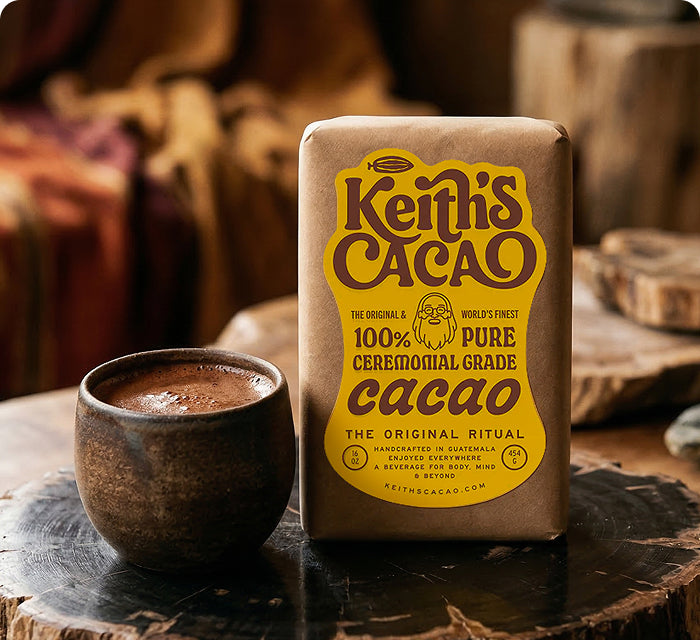
It's one of the most fascinating natural experiments in nutritional science. And it's exactly the kind of discovery that delighted Keith Wilson, the geologist, herbalist and healer who created Keith's Cacao, the original and world's finest ceremonial grade cacao in 2003 — a man who spent his life sitting at the intersection of science and spirit, sharing what he knew about cacao with anyone curious enough to pull up a chair.
Why ceremonial cacao benefits go far beyond regular chocolate
This is the part worth understanding, because it changes everything about how you think about cacao.
Most chocolate has been processed within an inch of its life. Roasted at high temperatures. Treated with alkalizing chemicals to kill the bitterness. Stripped down and rebuilt with milk, sugar, and additives until the original plant is barely recognizable.
A study in the Journal of Agricultural and Food Chemistry found this process destroys up to 60% of the antioxidants in the original bean. Dark chocolate retains roughly one-sixth of what was there to start. Milk chocolate? Around 7%.
Ceremonial cacao is different. It's cacao as nature intended: minimally processed, nothing added, nothing taken away. At Keith's Cacao, every bean is lightly toasted and peeled by hand in our workshop in Guatemala, then triple-inspected before being ground into the bar that reaches you. No machines cutting corners. No shortcuts. Just cacao in its most complete, most potent form, and with its flavanols fully intact.
Want to go deeper on what flavanols actually do? Read The Flavanol Power of Keith's Cacao — One Cup, Countless Benefits.
The broader picture on cacao and heart health
The stem cell study isn't a one-off. The research on cacao and heart health keeps building:
- Harvard Medical School found flavanol-rich cacao can lower blood pressure by 5 mmHg — comparable to 30 minutes of aerobic exercise per day
- The American Heart Association found cacao flavanols support healthy insulin response and stimulate nitric oxide production, helping blood vessels relax
- Brigham and Women's Hospital found that cocoa extract reduced the risk of major cardiovascular events by 27%
- A separate Brigham and Women's study found that seniors drinking cacao showed 86% increased blood flow to the brain after just one week
And that's before we get to theobromine — the natural stimulant in cacao that gives you calm, grounded energy without the jitters or the crash. Or anandamide, the so-called "bliss molecule," one of the rarest neurotransmitters on earth and one that cacao just happens to contain in abundance.
Curious about how this all adds up for your heart specifically? We wrote about that too: Cacao-Proof Your Heart.
This stuff is curious. Naturally.
Keith Wilson spent years on his porch in Guatemala sharing this with anyone willing to sit down and listen. A geologist and a healer. A scientist and a spiritualist. He understood, long before the studies, that there was something in cacao the modern world had forgotten.
The research is now starting to explain what he already knew.
If you've never tried real ceremonial cacao before, not the supermarket stuff, but the actual thing, this is your invitation. One cup. See what you notice.
Big change can start with a little sip.
The statements in this article are based on published peer-reviewed research. Cacao is a food, not a medicine, and is not intended to diagnose, treat, cure, or prevent any disease. If you have cardiovascular concerns, please work with a qualified healthcare provider.
SOURCES
- Lara et al., Journal of the American College of Cardiology — high-flavanol cocoa and stem cell mobilization
- Hollenberg et al., Harvard Medical School — Kuna people and cacao intake
- Harvard Medical School analysis on flavanol-rich cacao and blood pressure
- American Heart Association — cacao flavanols, insulin response, and nitric oxide
- Brigham and Women's Hospital — cocoa extract and cardiovascular events
- Journal of Agricultural and Food Chemistry — antioxidant retention after processing
SHOP KEITH'S CACAO
Our Ceremonial Cacao and hand-peeled Cacao Beans are the world's finest. We choose to rely on the amazing humans in our Guatemalan community and not on machines to produce our cacao. This minimal processing approach ensures you get the highest quality energy and nutrition cacao can deliver.
-
Ceremonial Cacao
Regular price From $33.00Sale price From $33.00 Regular priceUnit price / per -
Hand-Peeled Cacao Beans
Regular price $55.00Sale price $55.00 Regular priceUnit price / per